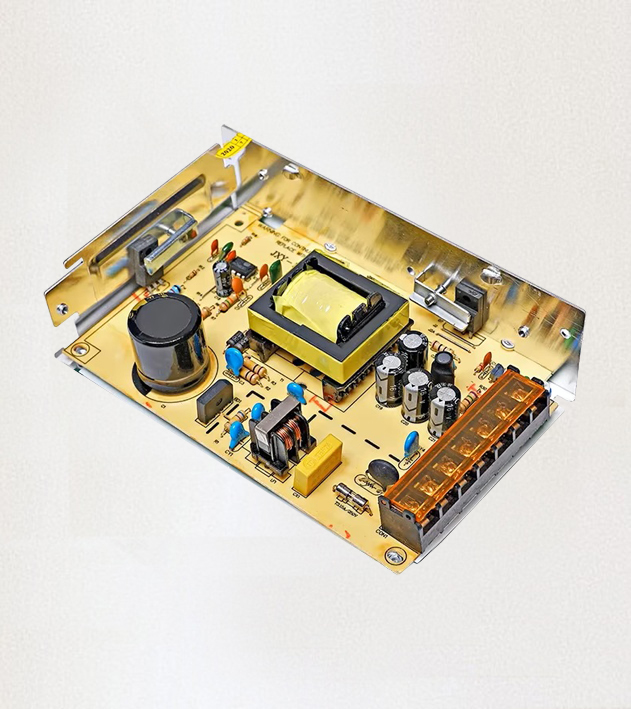
Every time the SamaraBoT arm lifts a part, rotates a joint, or closes its gripper, it needs energy. That energy comes from a single, small power supply that sits quietly on the desk next to the robot.
In this article we explain, in plain language, what the power supply does, why it matters, and what students can learn from it while building and running their own robotic arm.
What is a power supply?
A power supply is the part of the robot that takes electricity from the wall and converts it into the type of power the motors and control board can use safely.
Wall electricity is not what a small robot needs. It is too strong, and it does not provide the steady, controlled flow that stepper motors require. The power supply solves this problem: it lowers the voltage to a safe level, keeps it steady, and delivers it to the robot through a single cable.
Think of it like a translator. The wall speaks one language, the robot speaks another, and the power supply is the translator that makes them understand each other.
Why does a robotic arm need a steady supply?
Stepper motors are sensitive. They do not just spin — they move in small, precise steps, and they rely on a clean, stable current to do it accurately.
If the voltage drops suddenly, a motor may miss a step. If the current spikes, it may overheat or behave unpredictably. Both problems would make the arm lose its position and stop being repeatable.
A good power supply makes sure neither happens. It delivers the same voltage, all the time — whether the arm is standing still, moving slowly, or holding a part in mid-air.
What does the power supply power in SamaraBoT?
Inside SamaraBoT, the power supply feeds three main groups of components:
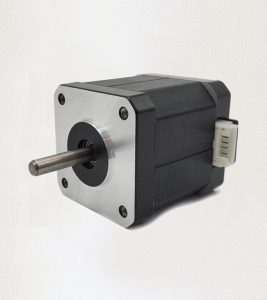
- The stepper motors — the muscles of the arm. Each joint has its own motor, and each motor needs a small but steady amount of current to move.
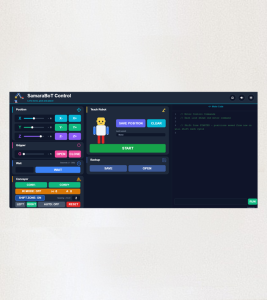
- The control board — the brain of the robot. It reads commands from the app, decides which motor should move and by how much, and sends the correct signal to each one.
- The sensors and small electronics — including the infrared sensor that detects parts on the conveyor belt.
All of these share the same power supply. If the supply is weak or unstable, every part of the robot feels it — the motors stutter, the sensor may misread, and the control board may reset in the middle of a task.
How does the robot turn power into motion?
The power supply delivers electricity to the control board. The control board then sends short electrical pulses to each motor. Each pulse moves the motor by one step. Hundreds of pulses per second become smooth, controlled motion.
This is why the robot can move so precisely. It is not one big burst of energy — it is a rapid series of tiny, identical pulses, each one moving the arm by exactly the same amount. The power supply makes this possible by keeping the electricity steady enough for the pulses to be accurate.
Why is the power supply important for safety?
A power supply is not just about performance — it is also about safety. A well-designed supply:
- Prevents overheating by limiting how much current flows to each motor.
- Protects the control board from sudden spikes in electricity.
- Keeps the voltage at a level that is safe for the electronics and for the students using the robot.
- Stops the robot cleanly if something goes wrong, rather than letting a fault travel through the whole system.
For a robot designed to be used by kids, this matters as much as the motors themselves.
What does a student learn from a power supply?
The power supply is a small box, but it teaches several important ideas:
- Every machine needs energy — and that energy has to be managed, not just delivered.
- Different parts need different amounts — motors, sensors, and the control board all have their own requirements.
- Stability matters — a small fluctuation can change how the whole system behaves.
- Safety starts at the source — good design prevents problems before they happen.
These are the same principles behind every powered device in the world, from a phone charger to the electrical systems of a factory.
A small box with a big responsibility
The power supply is easy to overlook. It does not move. It does not glow. It does not make the robot look impressive. But without it, nothing else would work.
When a student plugs in the SamaraBoT arm and watches it move for the first time, the power supply is the reason it happens. Understanding this small, quiet part is a first step toward understanding how every machine around us works.
That is the real lesson behind the power supply.