Every time a SamaraBoT robotic arm moves from one saved position to the next, a small black belt quietly turns inside the joint. It looks simple — a loop of rubber with teeth on the inside — but without it, the motor could not move the arm at all.
That belt is called a timing belt, and it is one of the most important mechanical parts of the entire robot.
In this article we explain what timing belts are, how they work inside SamaraBoT, and what students learn from them while building their own arm.
What is a timing belt?
A timing belt is a flexible loop made of rubber with a row of teeth on the inside surface. Those teeth mesh with matching grooves on two pulleys — one connected to the motor, and one connected to the part that needs to move.
Because the teeth fit into the grooves, the belt cannot slip. When the motor turns its pulley, the belt moves with it, and the second pulley turns by exactly the same amount. This is called synchronous transmission — the two pulleys always stay in perfect step with each other.
Timing belts are used in many machines, including 3D printers, CNC machines, and car engines. In every case, the reason is the same: they transfer motion precisely, with almost no loss.
Why does SamaraBoT use timing belts?
When we designed the SamaraBoT arm, we wanted a robot that could move smoothly, repeat the same position over and over, and do it with parts that students can see and understand.
Timing belts make this possible for three reasons:
1. They transfer motion precisely.
The teeth on the belt and the grooves on the pulley fit together, so there is no slipping. When the motor turns, the arm moves by exactly the right amount. This is what makes it possible for the robot to return to the same saved position again and again.
2. They reduce vibration.
A motor alone can be jerky. The belt acts as a soft link between the motor and the joint, absorbing small vibrations and making the movement feel smoother.
3. They are easy to see and understand.
A student can look at the belt turning inside the joint and understand immediately what is happening. Unlike gears hidden inside a gearbox, the belt is visible, and its purpose is clear.
How does a timing belt fit inside a SamaraBoT joint?
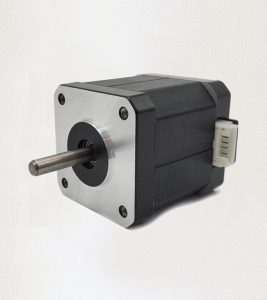
A SamaraBoT joint is a small assembly of parts. At one end is a stepper motor. At the other end is the arm link that needs to move. In between is the timing belt.
The motor has a small pulley attached to its shaft. The arm link has another pulley of its own. The belt loops around both pulleys, with its teeth fitting into the grooves on each one.
When the motor turns its pulley, the belt moves. Because the belt cannot slip, the second pulley turns by the same amount. The arm link moves, and the joint bends.
This is how the motor’s rotation becomes the arm’s movement. The belt is the bridge between them.
Why not just use gears instead?
A gear system also transfers motion from one part to another. So why does SamaraBoT use belts?
There are three reasons:
1. Belts are quieter.
Gears make a clicking sound when their teeth mesh. Belts are almost silent.
2. Belts can be placed farther apart.
The motor and the moving joint can be separated by some distance. A gear system would require them to be right next to each other.
3. Belts absorb shock.
If the arm meets an obstacle, the belt can flex slightly before the motor stalls. This protects the motor and the structure from sudden damage.
What are the different belt sizes?
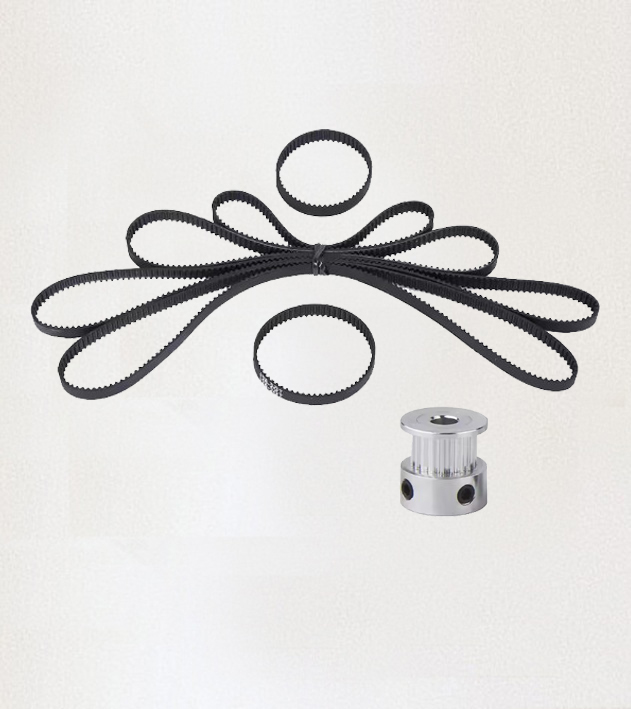
Timing belts come in many lengths. The numbers in the picture — 110, 112, 122, 158, 200, 280, 320, 400, 610, 852, 1140, 1220 mm — tell you the circumference of the belt loop.
A robot designer chooses the belt length based on the distance between the two pulleys. If the pulleys are close together, a short belt is used. If they are farther apart, a longer belt is needed. The belt must also have the right tooth pattern and width to fit the pulleys.
Getting the length right is important. A belt that is too long will sag. A belt that is too short will stretch and wear out quickly. The exact size in SamaraBoT was chosen to match the geometry of each joint.
What does a student learn from a timing belt?
A timing belt is a simple part, but it teaches several important ideas:
Motion has to be transferred.
A motor spins in one place. But the robot needs to move somewhere else. The belt is how that motion travels from the motor to the joint.
Precision comes from design.
The teeth on the belt and the grooves on the pulley are not decoration. They are what prevents slipping and keeps the robot accurate.
Different parts solve different problems.
A gear is good for short distances. A belt is good for longer distances and smoother motion. Learning to choose the right part is what engineering is about.
Small details matter.
If the belt is too loose, the arm wobbles. If it is too tight, the motor strains. The right tension is a balance that students learn to feel.
A quiet loop with a big job
A timing belt does not move on its own. It does not make noise. It does not glow. But without it, the SamaraBoT arm would not move at all.
It is a reminder that in robotics, the most important parts are not always the most visible. The motor gets the attention. The app gets the credit. But the timing belt is what turns the motor’s spin into the arm’s motion.
That is the real lesson behind every timing belt in SamaraBoT.