Inside every SamaraBoT joint, there is a small device that does something very simple but extremely important: it tells the robot when to stop.
It is called a micro limit switch. It is small, mechanical, and completely silent until it is needed. But without it, the robotic arm would not know where it is, and every movement would start from an uncertain position.
In this article we explain what a micro limit switch is, how it works inside the SamaraBoT arm, and why it is one of the most reliable parts of the entire robot.
What is a micro limit switch?
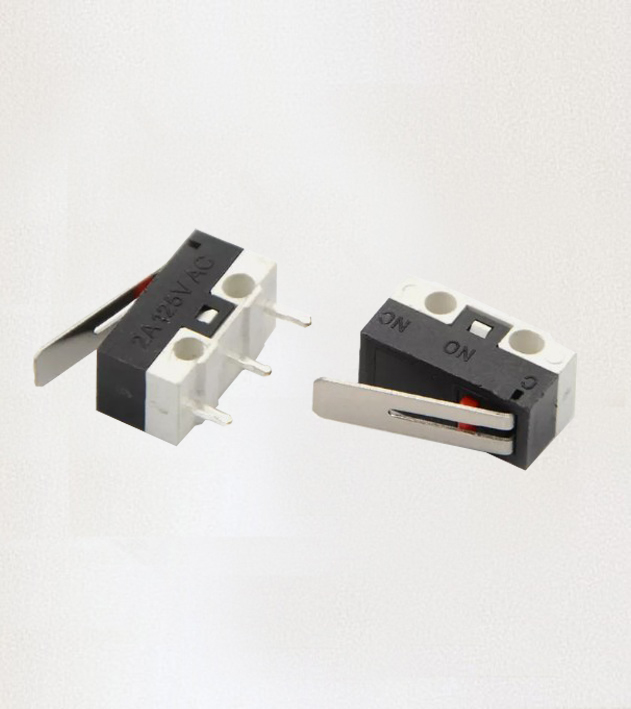
A micro limit switch is a small electromechanical switch that activates when a moving part touches its lever. The one used in SamaraBoT looks like a tiny black rectangle with a thin metal arm sticking out of one side, and three small pins underneath.
Inside the switch, a small spring-loaded mechanism keeps the lever in one position. When something presses the lever, the mechanism snaps to the other position and closes an electrical contact. When the pressure is released, the lever returns to its original position.
This snap action is what makes it so reliable. The switch does not gradually change — it changes instantly. It is either on or off, never in between.
What do the three pins do?
The micro limit switch has three pins, marked COM, NO, and NC.
- COM — the common pin. It is the shared connection inside the switch.
- NO — Normally Open. When the switch is not pressed, this pin is not connected to COM. When the lever is pressed, the internal contact closes and NO becomes connected to COM.
- NC — Normally Closed. The opposite of NO. When the switch is not pressed, this pin is connected to COM. When the lever is pressed, the connection opens.
In SamaraBoT, the switch is wired using the NO pin. This means the control board reads a signal only when the lever is actually pressed. In normal operation, no signal is sent — the robot can move freely. When a joint reaches its home position, the lever is pressed, the switch closes, and the control board receives the signal.
Where is the micro limit switch in SamaraBoT?
Every axis of the SamaraBoT arm has its own micro limit switch, mounted near the end of its travel range. The gripper also has its own switch.
Each switch is positioned so that a small mechanical part of the joint touches the lever when the joint reaches a specific point. This point is called the home position — the reference point that the robot uses to know where everything is.
Because there is one switch per axis, the robot can find its home position on every axis independently. It does not rely on guessing or on counting steps from the last time it was switched on. It simply moves until the switch tells it to stop.
Why does SamaraBoT need limit switches at all?
A stepper motor can move in very precise steps. But it has one important weakness: it does not know where it is when it is first switched on.
Every time the robot is powered on, its position is unknown. The motors may have been moved by hand while the robot was off, or the arm may have shifted slightly during transport. The control board has no way to know where the joints are.
This is called the homing problem, and it is one of the oldest problems in robotics. There are two common solutions:
- Use an absolute encoder — an expensive sensor that always knows its exact position.
- Use a limit switch — a simple, reliable mechanical contact that marks a known reference point.
SamaraBoT uses the second approach. When the robot starts, each joint moves slowly in one direction until it touches its limit switch. That is the home position. From that moment, the control board can count every step from a known starting point, and the arm can move to any saved position with confidence.
Why not just use a sensor instead?
Modern robots often use optical or magnetic sensors to detect position. These are fast and precise. So why does SamaraBoT use a mechanical switch?
There are three reasons:
- Reliability. A mechanical switch has no electronics to fail. It works in dust, in heat, and after thousands of cycles.
- Simplicity. A switch sends a simple on/off signal. There is nothing to calibrate or configure.
- Teaching value. A limit switch is something a student can see, touch, and understand. It teaches the idea of a reference point in the most direct way possible.
For a robot designed to teach real automation, reliability and clarity matter more than the latest technology. A student who understands how a limit switch works will understand the same principle in every industrial machine they encounter later.
How does homing actually work in SamaraBoT?
When the robot is switched on and connected to the app, it performs a homing sequence. Here is what happens, in simple steps:
- Each joint begins to move slowly toward its limit switch.
- When the lever of the switch is pressed, the switch closes.
- The control board reads this signal and stops the motor for that axis immediately.
- The position is recorded as the home position — the reference for everything that follows.
- Once all axes have reached home, the robot is ready to receive commands.
This entire sequence takes only a few seconds. It is safe, predictable, and it guarantees that the robot always starts from the same known position.
What does a student learn from a limit switch?
A limit switch is a small part, but it teaches several important ideas:
- Reference points: every precise system needs a known starting position.
- Mechanical feedback: a switch is a physical way for the machine to sense the world.
- Safety: the switch also acts as a stop. If a joint moves too far, the switch is pressed and the motor is stopped before anything breaks.
- Reliability through simplicity: sometimes the oldest, simplest solution is still the best one.
These are the same principles that operate inside industrial robots, CNC machines, and 3D printers. The limit switch a student sees in SamaraBoT is the same kind of device that runs inside a real factory.
A small click with a big meaning
When a SamaraBoT arm starts moving and reaches its home position, you can hear a tiny click. That click is the sound of the limit switch closing.
It is a small sound, but it means something important: the robot knows where it is again. It can now move with precision, return to any saved position, and run any program the student has created.
Without that click, the robot would have no reference point, and none of its movements would be repeatable.
That is the real lesson behind the micro limit switch.